

SUGAR
History
Even something as sweet as sugar is complicated.
Some say that the history of Cuba can be told in the island’s relationship with sugar. Even though sugar production has decreased since the fall of the Soviet Union, raw sugar still accounts for more than a quarter of Cuba’s total exports. (raw sugar alone is $378 million of Cuba’s $1.4 billion exports, as of 2015.)
Cuban sugarcane began being grown commercially, in 1523. (thanks Spain!) In the 1700’s, the industry was finally profitable. Sugar plantations relied heavily on slave labor. More than a million Africans were brought to Cuba between the 1600’s and 1867. It’s not surprising that in her history lesson, Ines (played by Idalmis) sums up a good portion of Cuban History with the words, “Sugar! Sugar, sugar, sugar.” As the world’s appetite for sugar increased, so did Cuba’s production.
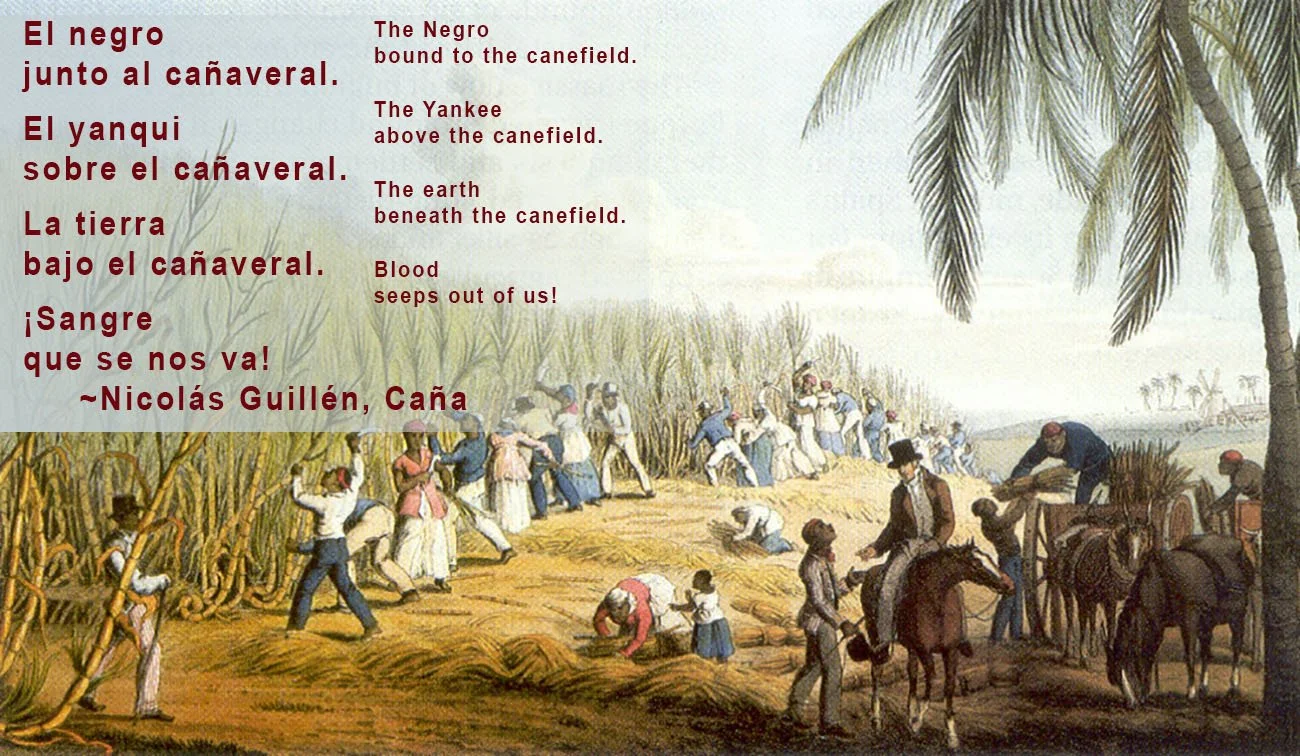
Cuban Poet Nicolás Guillén, Painting from Saba
Under Fidel Castro’s rule, Cuba attempted to diversify away from sugar, but when that did not prove to be as profitable, he set the goal of harvesting ten-million tons of sugar, known as La Zafra de los Diez Millones, the Ten Million Ton Sugar Harvest. Unsurprisingly, the CIA did extensive research on the Cuban sugar economy in the 1960’s and worked hard to sabotage this crucial cash crop.
Despite all this effort, they couldn’t reach ten million tons of sugar, and this failure was one of the toughest blows to the country’s morale.
Since then, sugar has become a symbol of hard work, unity, resistance and strength in Cuba, always tinged with a deep feeling of disappointment. In Cuba, sugar tastes at the same time of the sweetness of the cane and the terrible bitterness of the harvest. -clandestina.co